What’s on the Turntable: Sgt. Pepper, One Side at a Time
Some records arrive carrying more baggage than the band did. Best-ever lists. Anniversary editions. Arguments about which mix you are supposed to love. Somewhere in all that, putting on an album starts to sound like homework.
Let’s not do that.
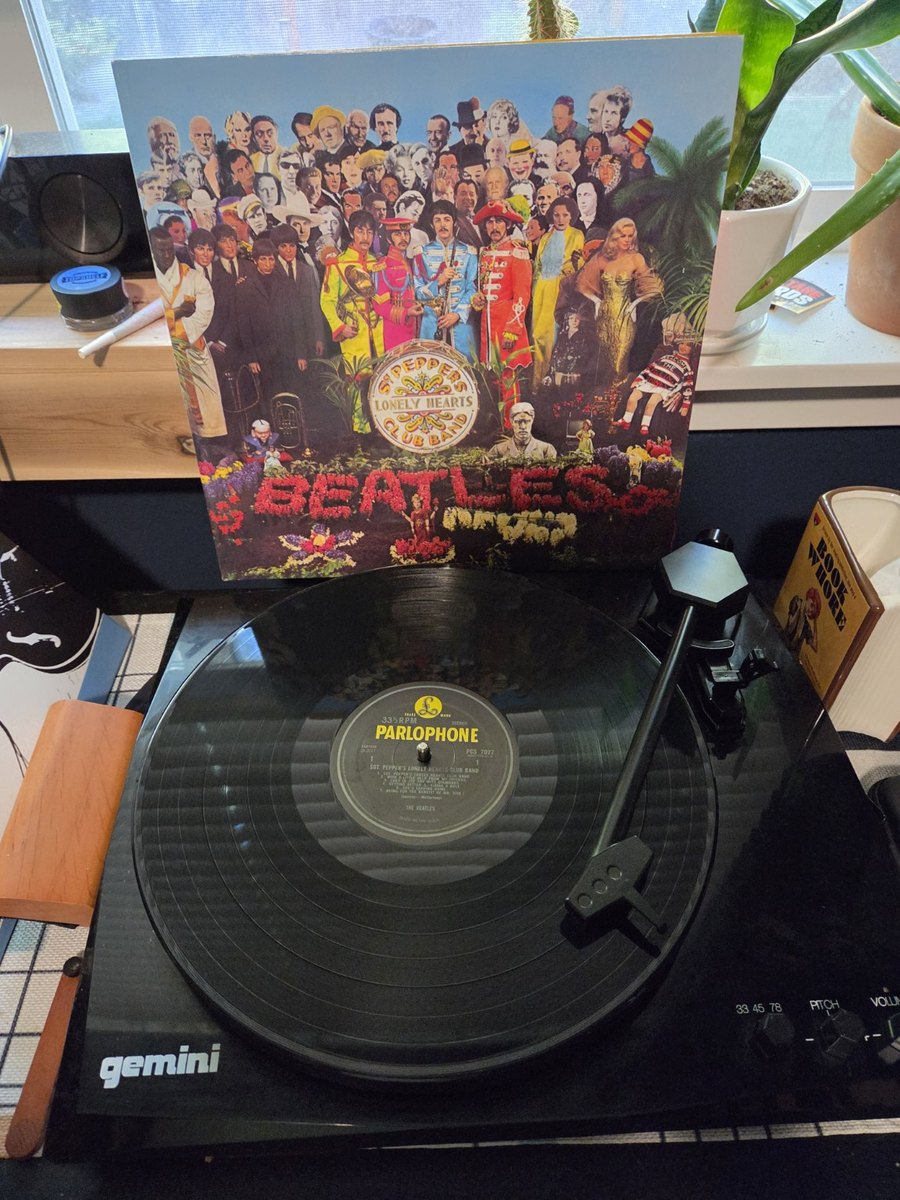
For this edition of What’s on the Turntable, the starting point is a real photo from Erik’s collection: The Beatles’ Sgt. Pepper’s Lonely Hearts Club Band, a black record on the turntable, the sleeve behind it, and plants by the window. A lived-in corner, a familiar sleeve, and a reason to give the music a little attention.
This is a listening guide, not a review of the particular pressing in the photograph. The photo does not establish its release year, mastering, or mix.
The useful bit of history
Sgt. Pepper came out in 1967. With touring behind them, the Beatles could spend more time building recordings without having to reproduce every detail onstage. The official album history describes the band and producer George Martin stretching what they could do with four-track recording equipment. [1]
That is enough background to get started. You do not need a dissertation on the Summer of Love before dropping the needle.
Try approaching it as a collection of changing scenes rather than a museum exhibit. The question is not “Do I agree with its ranking?” It is “What catches my attention when I stop treating these songs as things I already know?”
Side one: listen to the handoffs
Start at the beginning instead of jumping straight to the song you came for. The opening title track leads into With a Little Help from My Friends; the album’s familiar introduction gives way to a different voice and a different kind of invitation. Those are the first two tracks in the published sequence. [2]
For this pass, make the transitions your little assignment. Not a test—more like watching the scenery change out a train window. When a song ends, leave a moment to notice how the next one changes the room. Does the pace seem to lift? Does the arrangement feel fuller or more exposed? Does a voice pull your attention back from the instruments?
You do not need the technical name for any of it. “That little thing behind the singing” is a perfectly acceptable listening note.
For a specific stop, try She’s Leaving Home. The official song notes credit Mike Leander’s string arrangement and point out that the Beatles do not play instruments on this recording. [4] Listen for what that absence does: instead of following a rock-band groove, try following the voices against the orchestral backing. Does the scene feel closer, more formal, or more unsettling to you? The arrangement gives you something concrete to notice without requiring you to name every instrument.
The flip is part of the evening
The Beatles’ official history notes that the original album was not banded into the usual visible track divisions, encouraging listeners to play through and pause to turn the record over. [1]
Use that pause. Stand up. Look at the sleeve. Refill your coffee. Let the first side finish being its own thing before starting the second.
Listening digitally works too. Keep the album in sequence, switch off shuffle, and pause at the side break. The ritual does not require buying a turntable, a different cartridge, or somebody’s supposedly essential pressing.
The point is to choose the music for a little while, rather than constantly choose what comes next.
Side two: give the ending somewhere to go
The published sequence opens the second side with Within You Without You and closes with the title-track reprise followed by A Day in the Life. [2]
Those bookends give you two things to pay attention to. First, how does the start of the second side feel after the first? You may settle into it immediately, or you may find yourself wanting the record to hurry along. Both reactions are worth noticing. Nobody is grading your appreciation.
Then resist skipping to the finale. Let the songs before it do their work. When the reprise arrives, ask whether it feels like a return, a closing announcement, or something else entirely. Carry that impression into the last track.
After the final sound, leave a short silence before starting another record. Not because silence is sacred. Because immediately filling it with an app recommendation can make the end feel like just another transition in an endless feed.
About those mono-versus-stereo arguments
There are different mixes to explore. For the 2017 anniversary release, Giles Martin and Sam Okell created a new stereo mix using the original session tapes, with the original mono mix as a guide. [3]
That can be an interesting comparison later. It does not make the copy already on your shelf the wrong one.
For this listen, use what you have. A pressing identification needs more than a distant view of the jacket; we are not assigning collectible value or making sound-quality claims about Erik’s copy from a photograph.
One small thing to take away
At the end, pick one moment you would play for someone else. It might be a handoff, a backing part, a change of pace, or the whole final track. You do not owe anybody a top-ten list or a definitive verdict.
That is the idea behind What’s on the Turntable: real records, real photographs, and a reason to spend some time with the music—not another excuse to turn a pleasant evening into a gear purchase.
Which album makes you want to play the whole side instead of just your favorite track?
Sources
[1] The Beatles — official album history. https://www.thebeatles.com/sgt-peppers-lonely-hearts-club-band-0
[2] The Beatles — published album sequence. https://www.thebeatles.com/sgt-peppers-lonely-hearts-club-band
[3] The Beatles — 2017 anniversary edition and mixing notes. https://www.thebeatles.com/beatles-celebrate-anniversary-sgt-peppers-lonely-hearts-club-band-special-edition-release
[4] The Beatles — She’s Leaving Home, song and arrangement notes. https://www.thebeatles.com/shes-leaving-home
Sources checked October 7, 2026. Listening guide: ForTheStoner Editorial. Original photograph: Erik / ForTheStoner.