
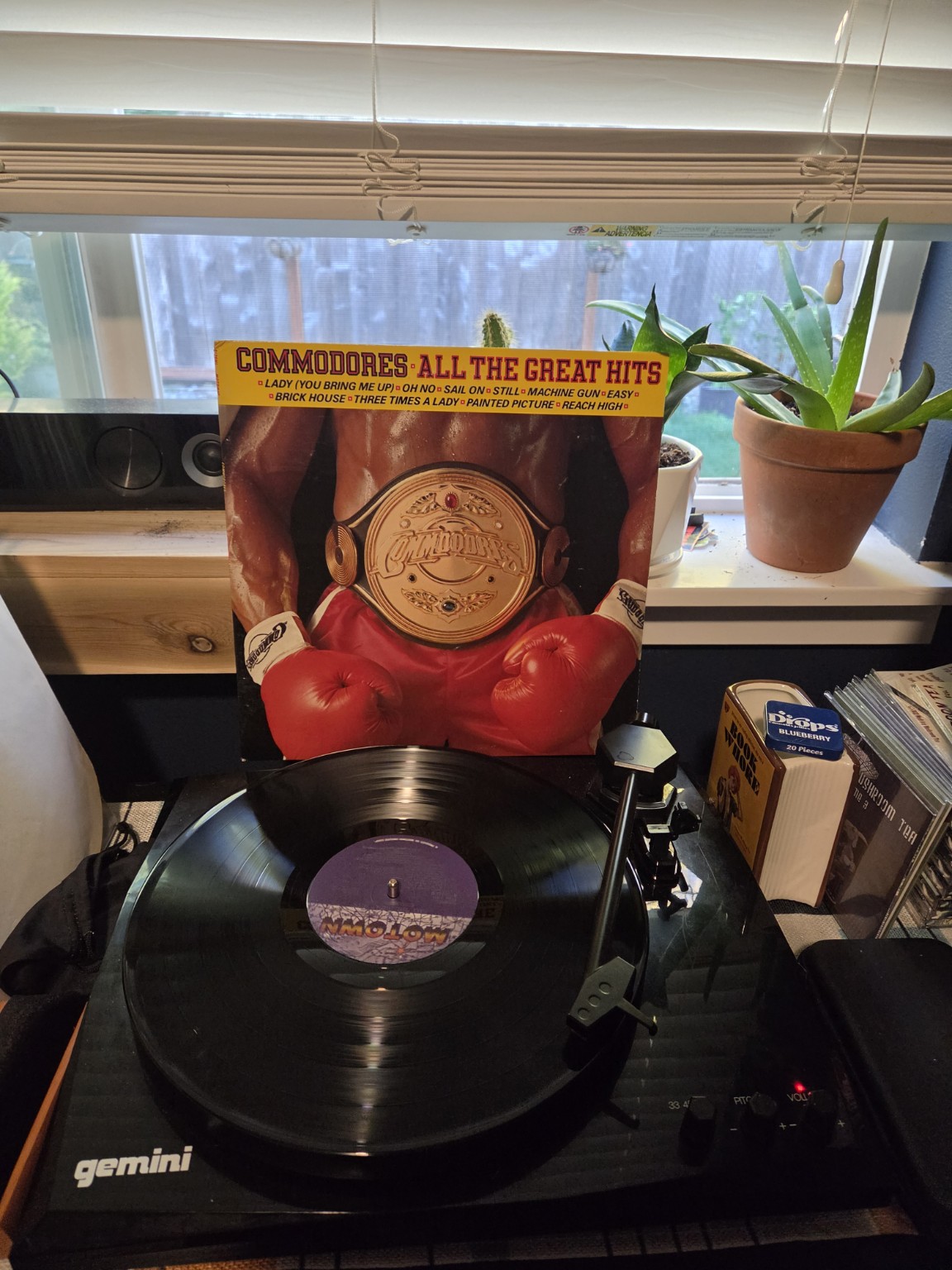
The bass line in “Brick House” has more confidence than most people manage in a lifetime. A few notes, a little space, and there it is: an entire personality. Then Walter Orange starts singing, gloriously pleased with the subject under discussion, and the record acquires a dirty grin.
I love how little effort it appears to require. The groove is firm, the vocal is loose, and every little interruption seems to make the thing more sure of itself. There is craft all over this recording, but the pleasure arrives immediately. It sounds like a band having an exceptionally good idea together.
The sleeve of All the Great Hits is almost as subtle. Red boxing gloves. A championship belt. The sort of artwork that would be embarrassing if the songs couldn't back it up. Fortunately, the Commodores have brought “Brick House,” “Machine Gun,” “Easy,” “Sail On,” and several other excellent arguments to the weigh-in.
Six people made this sound
Lionel Richie's fame can cast a very large shadow over the Commodores. The records keep showing how much was happening around him. Orange sings the lead on “Brick House”, and the songwriting credit belongs to the whole six-member band. “Easy,” written by Richie, appeared beside it on the same self-titled album in 1977. That is an absurd amount of range to have sitting on one record.
“Machine Gun,” their first hit, didn't require a singer at all. That busy little keyboard figure has plenty to say on its own. Beneath it, the rhythm is tight enough to keep the repetition exciting.
This is what makes the early funk so satisfying to me. The parts have personalities. The bass can be blunt, the keyboards restless, the voices exuberant, and the whole arrangement still feels wonderfully secure. A good band gives its members something solid enough to get loose on. The Commodores had that.
“Easy” is a beautiful piece of work
Then there is that piano opening.
“Easy” has such a welcoming surface that the ache underneath can come as a surprise. Richie sounds tired of struggling, and the melody gives that exhaustion a kind of grace. I hear relief in the song, with a little sadness still caught in it. The singing never seems desperate to prove how much feeling is available. The feeling is already there.
And I love the guitar solo. Its rougher edge puts a little grit into all that softness. The arrangement can accommodate it; the song gets bigger for a moment without losing its composure. That is one of the things I admire most about the Commodores: even when Richie is holding the center, the band still has a voice.
“Three Times a Lady” is far less guarded. It makes an enormous declaration of affection and means every inch of it. The slow sway, the long vocal lines, the way the refrain opens up—there is considerable skill involved in making something this direct hold together.
I am more partial to the slightly frayed calm of “Easy,” but I like the commitment here. “Three Times a Lady” goes all the way with its sentiment. A halfhearted version would be unbearable. Richie gives it the conviction it needs.
“Sail On” has another flavor altogether: a country warmth in the phrasing, a soft surface, and a man sounding increasingly ready to be finished with the business at hand. I like the tension between the pretty sound and the resolve. The Commodores could make a goodbye feel almost buoyant.
Then “Lady (You Bring Me Up)” comes along with that bright, generous chorus. It has a different kind of release in it, the uncomplicated pleasure of a song that seems to get happier as it goes. That lift is one of this collection's great pleasures.
The pleasure of having them together
A hits collection can reveal a band through proximity. These songs share a sleeve, and suddenly the breadth becomes obvious: Orange's rough good humor, Richie's melodic generosity, the instrumental nerve of “Machine Gun,” all those ways the rhythm section can make a song feel alive.
All the Great Hits is a record I like for its company as much as its individual songs. It has warmth, nerve, and a thoroughly enjoyable lack of embarrassment about being a crowd-pleaser. The tenderness feels right beside the swagger because the musicians sound at home in both.
If “Brick House” were all they had, I'd still want the record. “Easy” is why I'd be glad I bought the whole damn thing.