
There ought to be a small fine for putting on Sam Cooke and immediately opening your email. Nothing ruinous. Five dollars, perhaps, paid into a fund for people who have finally had enough of being available.
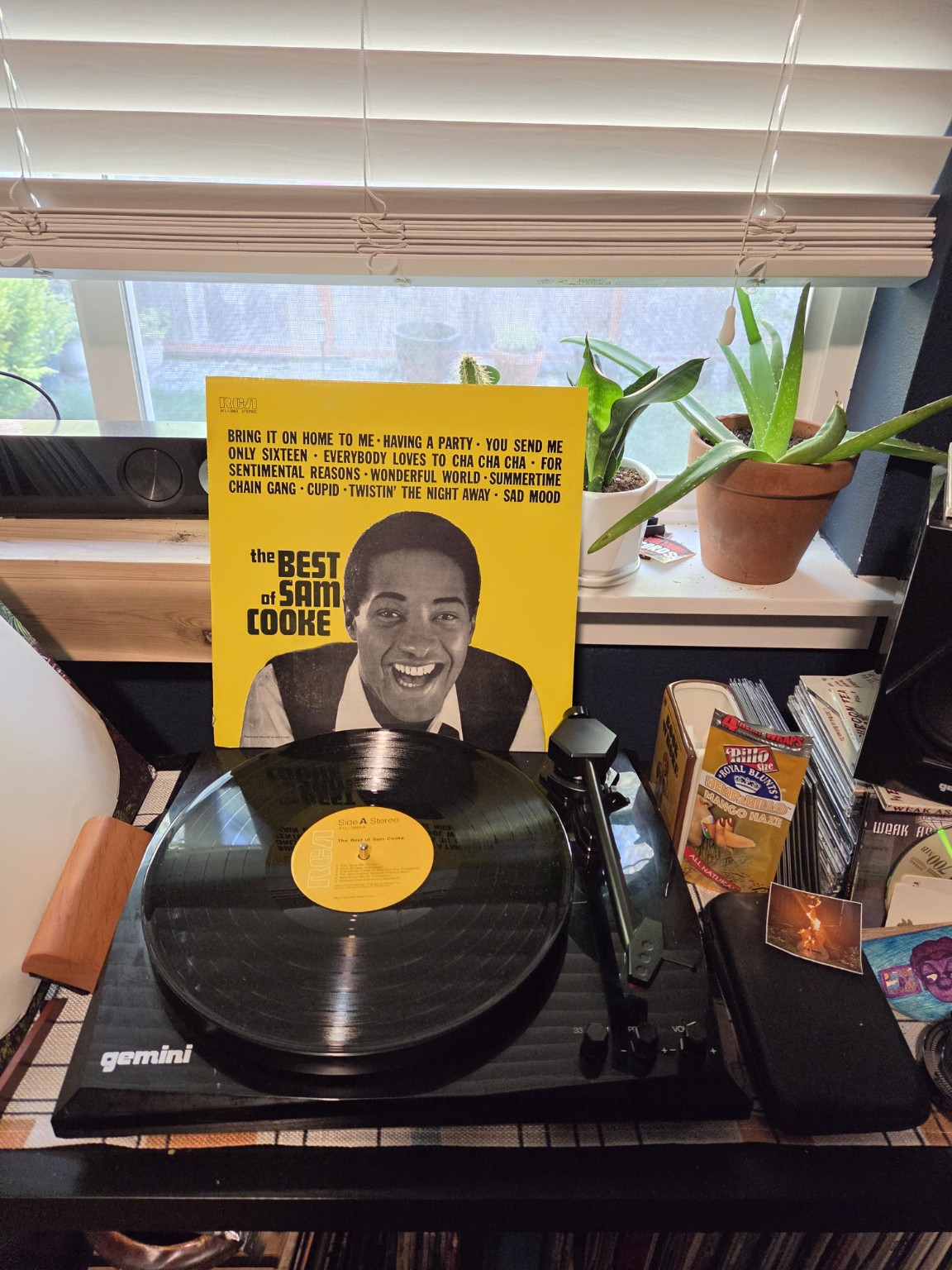
The photograph from the ForTheStoner collection is exactly the sort of scene I associate with him: a yellow Best of Sam Cooke sleeve, a black record on a Gemini turntable, daylight at the window, a few plants minding their own business. No velvet rope. No museum lighting. Just music in an actual room.
That suits Cooke because the miracle of his voice is how little it seems to need from the room around it. He can sound polished without becoming chilly, smooth without turning anonymous, and wounded without acting as though the listener owes him a standing ovation for having feelings.
The famous songs earned their fame
“You Send Me” is almost absurdly easy to underestimate because it has been famous for so long. The melody feels inevitable. Cooke lets the words float without losing the pulse underneath them, and the whole performance has the calm confidence of somebody who knows the song is going to work and sees no reason to sweat in public.
“Cupid” has more playfulness in it. “Bring It On Home to Me” has more weight. “Having a Party” opens the windows and lets everybody in. Those songs sit together on ABKCO's The Best of Sam Cooke listing, and together they show what a remarkable trick he kept pulling: the same voice could sound intimate, flirtatious, pleading, or communal without ever sounding like it had changed owners. ABKCO — The Best of Sam Cooke
Familiarity can turn great records into wallpaper. That is not the record's fault. It is one of the hazards of surviving long enough for something you love to become a standard.
Night Beat is where the room gets smaller
I am especially fond of Night Beat. ABKCO dates those sessions to February 1963 in Los Angeles, and the album opens with “Nobody Knows the Trouble I've Seen,” “Lost and Lookin'” and “Mean Old World.” ABKCO — Night Beat
“Lost and Lookin'” is the one that gets me. It is spare enough to make the empty space part of the performance. Cooke does not need a mountain of arrangement to make a line feel inhabited. A bass, a cymbal, that voice, and suddenly the room seems closer.
That restraint is part of what makes him extraordinary. Plenty of singers can show you everything they have. Cooke often sounds better for what he refuses to force. He lets a phrase arrive, turn slightly, and leave before anybody has had time to put a frame around it.
There is a kind of confidence in that which expensive stereo equipment cannot manufacture.
The gospel years matter
Before the pop hits, Cooke sang with the Soul Stirrers. Concord's The Complete Specialty Recordings includes “Jesus Gave Me Water,” “Be with Me Jesus” and “Touch the Hem of His Garment,” and places his gospel breakthrough in the early 1950s. Concord — The Complete Specialty Recordings
You can hear why that history matters. The relationship between lead voice and group, the way a phrase gathers force from the response around it, the ability to make a line feel both personal and larger than one person—none of that appeared out of nowhere when the records started crossing over.
“Touch the Hem of His Garment” has that combination of control and urgency I keep hearing in Cooke's best work. The voice is beautiful, but beauty is not the whole business. There is intention in it.
And then there is Harlem Square
The polite version of Sam Cooke is not the only Sam Cooke. One Night Stand! Live at the Harlem Square Club, 1963 was recorded in Florida on January 12, 1963, and includes live versions of “Cupid,” “Bring It On Home to Me” and “Having a Party.” ABKCO — One Night Stand!
That record has sweat in it. The voice is rougher, the crowd is present, and Cooke sounds less like the immaculate figure preserved by old television footage and more like a man working a room full of people who have no interest in being impressed quietly.
I love that contrast. The studio records make elegance sound easy. Harlem Square reminds you that elegance was only one of the things he could do.
Maybe that is why his music still fits so well in an ordinary room decades later. It does not require reverence. It can carry romance, loneliness, joy, faith, and a little trouble without turning any of them into homework.
The yellow sleeve can stay beside the turntable. It has earned the space.